Early Season Base and Spinervals Super 6

I confess with both my readers as my witness: I’m not a big fan of aerobic base building. Like a lot of things I know are good for me, I know I should be doing it before I move into the fun stuff — intervals and threshold — but I just find it mind numbing. Particularly the long aerobic ride. Particularly solo.

But one needs to work on one’s “limiters,” as the data-driven endurance coaches say, and one of mine is definitely cycling endurance. Other than Ironman Arizona 2010, all of my Ironman rides have been far below what I’m physiologically capable of doing. It doesn’t matter that you’re a decent runner if you lose 30-60 minutes in the bike. What I did differently in 2010 was do some well-timed volume on the bike in that high Zone 2 / low Zone 3 area, so that seems like something I should get back to.

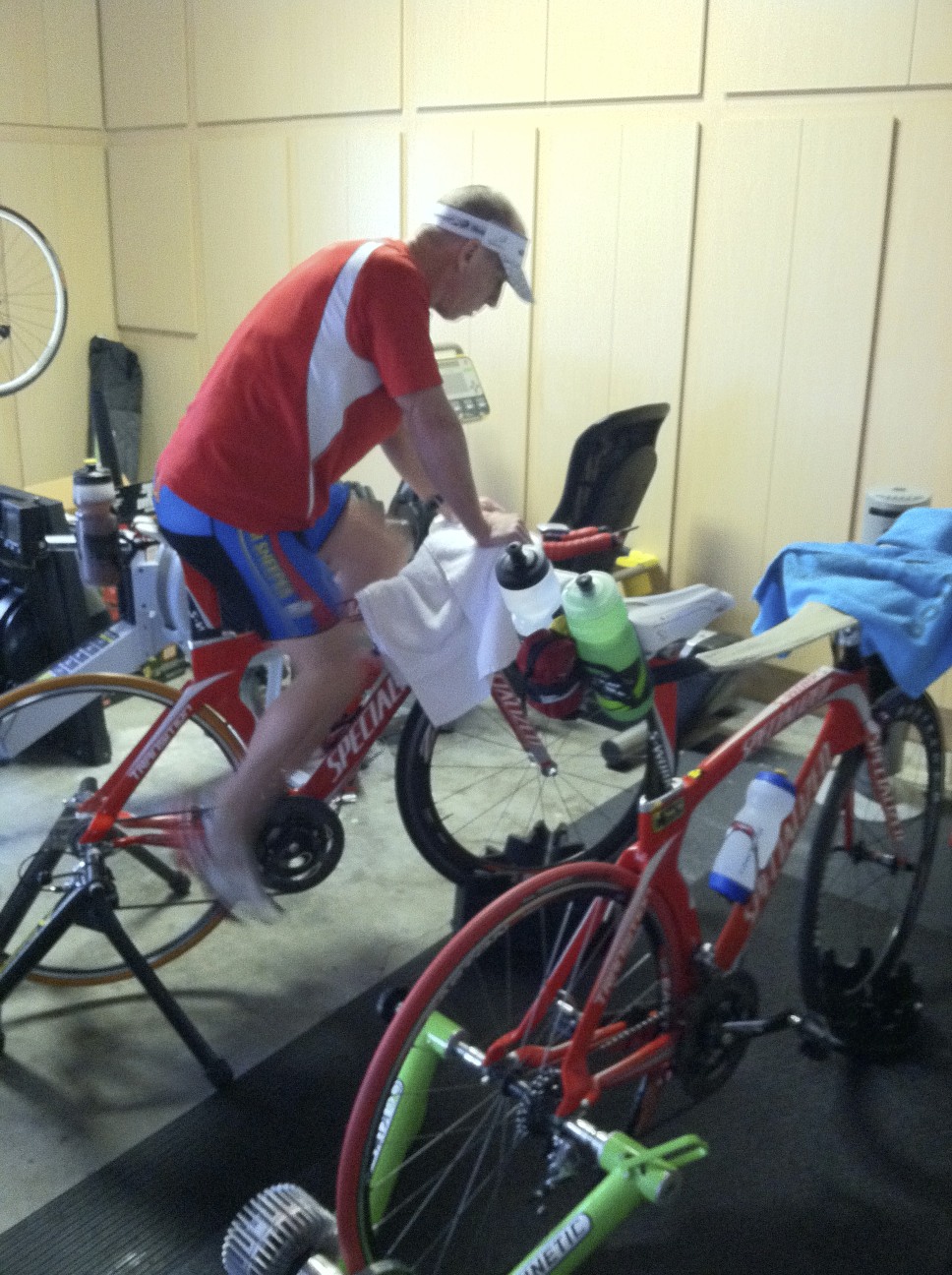
To kick off the year in style, I’ve been following the Spinervals Super 6 program. I’ve been a Coach Troy fan for many years and got a chance to meet him in person at an Ironman breakfast in Kona this past October, though of course I felt like I already knew him thanks to many hours of suffering through his workouts in my garage. Basically, the program is six weeks of six rides per week with running and strength work thrown in for good measure (it doesn’t address swimming — for that you’re on your own). During the week, it’s got a mix of intensity (my fave) with steady aerobic work, but the Saturday ride gets long. Today’s was very long indeed — 100 miles in about 5.5 hours, for those hardcore types who can stay on the trainer that long. Short option was 3-4 hours. I enlisted the company of my good friend and teammate Mike, who like me has Ironman Arizona on the docket this year.

I barely made it to 3.

It started fine and controlled, but in the second set the intensity went up, and the gearing Coach Troy was using seemed too high on the fluid trainers we had — I hit over 300 watts in the last minute of the first repeat. This is higher than I can even maintain in a sprint distance triathlon, so well above lactate threshold. My heart rate never really recovered from that; where my aerobic efforts had been below 130, I was consistently staying above 140 for much of rest of the workout, which meant I had burnt a lot of matches during that set. Effectively, I bonked and made it to 3 hours only by force of will.

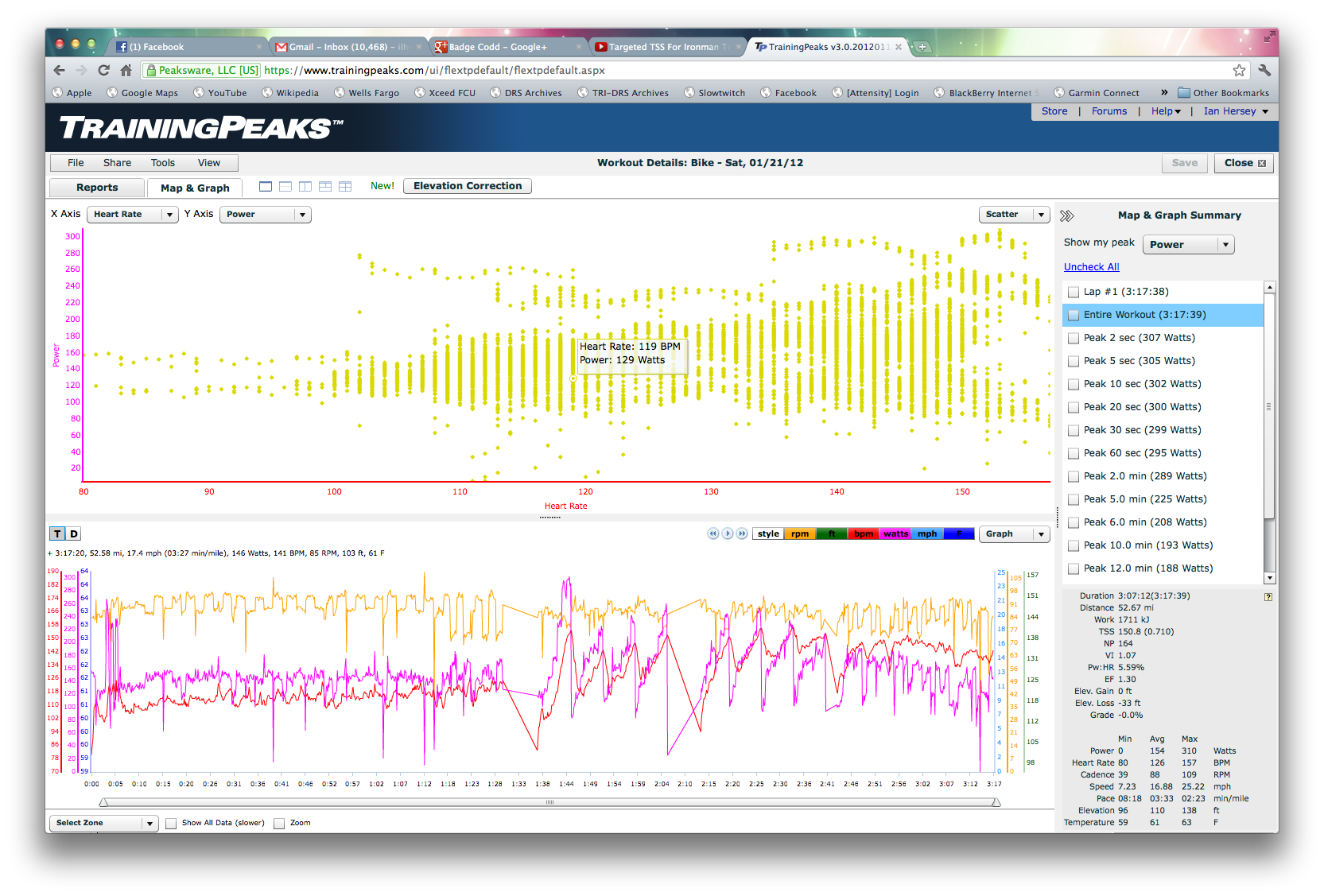
Looking at the workout in TrainingPeaks, the graphs tell the story. In the bottom graph, you can see the correlation between heart rate and power as the workout goes on; in the third hour, the power goes down but the heart rate stays high. In the scatter graph (one of the new beta features I have access to), if you plot power and heart rate data points, you see a wide fan-out of power and heart rate at the upper end of the X axis (heart rate); normally you would expect a smoother upward trend on both axes.

What this tells me is that I have a lot more long aerobic work to do, and it also illustrates what happens when you go into the red zone during a long aerobic effort — you burn enough matches to end your day prematurely.

Live and learn. 🙂

Catching up in the New Year

I’m perennially running late, and so it is with race reports, years in review, etc. 2011 was a pretty good year, training-, racing- and otherwise.

Highlights:

  • Two marathons within 13 days, by far the shortest time I’ve ever had between races of that magnitude (previous shortest was 11 weeks.
  • Second Hawaii Ironman (tenth Ironman overall), with a 37-minute time improvement
  • Being selected as a TrainingPeaks Ambassador for 2012

I think I’m probably proudest of the marathon double (3:03:08 at Boston and 3:04:57 at Big Sur), especially since a calf strain severely curtailed my training leading up to Boston — I averaged 11 miles per week from the beginning of February through Patriots Day. Compensated for by lots of cycling, swimming and muscle memory, of course.

Still, I think that double hurt me in Kona. My cycling never really came together, especially for longer rides. And my bike crash in Big Kahuna didn’t help, either; I still have some scars from that one, literally.

For 2012, I am renewing my focus on cycling strength, kicking things off with the Spinervals Super 6 on TrainingPeaks. I’m also having fun beta testing some new TP features (more on that in another post). As a software company CTO, though, I have a bunch of other suggestions; I’m reining myself in for now.

Ironman Arizona 2010

The executive summary:

PR by 5 minutes and bike PR by 14 minutes

This was a 5-minute PR for the Ironman distance and my ninth Ironman overall, but what I’m most stoked about is a 14-minute PR for the bike.  I also won the “46 and over” category in the Ironman Executive Challenge, which got me a Kona slot for 2011 – hoping Lance Armstrong shows up for that race.  🙂

Like every race of this distance, there are a thousand stories, most of them boring.  It’s a long day, so lots of little things go right and wrong.  You are guaranteed to have high points and low points.  But most of the story, actually, is in the training leading up to the race – that’s where the hard workouts are done, many of which no one else sees but you – the 3+ hours on the bike trainer in a hot garage, the hours on the dryland swim trainer to build shoulder strength, the hard solo runs after the group bike ride where everyone had hammered the hills, the endless sets of planks and lunges to build core strength.  Those sessions are where your race is made or broken.

Anyway, I had done the work, so the plan on race day was to put it to the test.  This was only my second race of 2010; in the spring, I had a persistent hamstring strain, which kept me out of the Big Sur Marathon, and a planned appearance at the brand-new Ironman Regensburg in August was canceled due to some work stuff.  So other than a sprint tri back in May, IMAZ was my only showcase for the entire year.  I wanted to make it count.

I almost blew it in the swim; I lined up on the far right on the “wall,” which would have been ok if I had gotten myself closer to the front.  But the wall area was crowded, so I thought I’d let the pack go and then swim through it later once it had spread out – that worked well in IM Austria a couple of years ago.  Big mistake.  All it meant here was that I had a bunch of slower swimmers in front of me once I set off (two minutes after the gun), and it took a while to get past them.  Not a good strategy.

My other rookie mistake was wearing the wetsuit I got a great bargain on at the Ironman shop the day before – a beautiful 2XU creation that I got for half price.  It fit perfectly and all, but I hadn’t noticed that there was strip of cloth over the Velcro closure to prevent its snagging on anything else, and that meant that my wetsuit didn’t really close.  About 2/3rds of the way into the swim, I felt some water coming in the top, and I had no idea why – I thought the zipper was coming down.  Fortunately, it stayed up, but it was on my mind the rest of the swim.

hammer time!

Once out on the bike, I settled down and found myself cruising the “out” portion of the out and back pretty fast – as fast as 28 mph.  That could only mean that we had a tailwind, so there would be a pretty good headwind coming back.  Sure enough, that was true, and it seemed to get stronger on each of the three loops.

I was going by power anyway, so I just kept myself down in the aerobars and cranked away.  I noticed after the first loop that I was holding close to a 21 mph average, which is about 1 mph better than I had ever ridden in an Ironman.  What’s more, I felt great and well within myself.

On the second loop came my first dilemma – pee while on the bike or stop?  Warning:  possible TMI coming.  I had never tried the “peeing while moving” thing before, but since I was on a good ride, I didn’t want to lose time.  The problem was that you’re normally supposed to do this on a downhill when you can coast; the downhill in the race was into a headwind, so there wasn’t much coasting to be had, so I took the opportunity to try it on a false flat on the uphill with the tailwind.  Get off the saddle, stop pedaling, move to one side, and relax.  Ahhhhh!  Douse yourself with water, and Bob’s your uncle.  That was so successful I did it four more times during the ride.  🙂

That business aside, I was still holding my pace and even surprisingly caught a teammate of mine who’s a really strong swimmer and cyclist about 5 miles from the end of the bike.  I almost flubbed my good day, though, while getting ready for the bike-to-run transition – I started pulling my feet out of the shoes and putting them on top so that I could do a quick dismount, and when I got my left foot out, my leg started cramping and I couldn’t get my foot on top of the shoe.  This started a comical series of attempts, where the shoe was hitting the ground and almost either coming out of the pedal or causing me to crash, but I finally got it right.  Not my shining moment.

Coming off the bike, I was happy with my time – I was getting onto the run course about 15 minutes faster than I ever had, so I knew a PR was possible – but I wasn’t happy with how my legs felt.  There was no oomph.  I settled into a manageable 7:40-8:00 pace, and was running along with my teammate Jeff (the one I had caught on the bike) for probably 5 miles or so, during which point we were both passed by the 2nd-place woman Linsey Corbin, who was a loop ahead of us.  The one long uphill of the loop came, and I fell back while the 3rd and 4th female pros went by me (3rd I didn’t recognize, but 4th was Leanda Cave).

I was now running 8:30s, and really starting to hit a low patch.  A few pit stops ensued, thanks to my good hydration strategy (plus a two-minute stop to read the Wall Street Journal in the port-a-potty :-)), but otherwise I kept motoring along as best I could, knowing that it probably wouldn’t get any worse and might get better.  At the end of the second of the three loops (17 miles in), I did some quick math and saw that I could still break my PR as long as I could hold it under 9-minute pace.  That became my mission for the rest of the race.

Two miles later, I caught up to Jeff, who was now walking.  Not good – once you start walking in an Ironman, you’re done.  I was starting to feel better and was able to pick it up a little – I figured every 30-45 seconds per mile under 9:00 I could put in the bank would give me a buffer if something bad, like a cramp, happened.

With two miles to go, I was really working it but also running a lot faster than I had done the rest of the race – I always do that when I’ve got something left and “smell the barn.”  The 8:30+ pace had become sub 7:30, and I was passing a lot of people.  At about mile 25.5, I caught up to another Executive Challenge guy, Adrian, who was in a younger age group.  As I went by and said “way to go,” he asked me which loop I was on.  “The last,” I grunted out.  All of a sudden, I could sense there was someone on my heels.  Damn, I thought – I’m going to have a sprint finish in an Ironman.

I led through the series of turns that took us to the finish line, and I was running sub 6:30 pace at this point, at least according to my Garmin watch.  I didn’t know exactly where Adrian was, but that became clear when he rocketed past me in the final 50m to gap me by two seconds.  But that’s cool – I still got my Kona slot, since he wasn’t in my age group, and I got my PR.  Adrian didn’t look so good when I went up to congratulate him – they carted him off in a wheelchair to the med tent.  Lesson:  you can outsprint the old man, but it’ll cost you.  😉  Seriously, though, it was fun to have a little testosterone-fueled contest at the end of a long day, even if I was on the losing end.

So I got my PR and my Kona slot for next year, which means I can build my season around the event already being in the bag.  What’s more, I’m finally happy with my bike – my bike time ranked higher in the age group than my run time, which is a first.  That means my transition from runner to triathlete is almost complete.  Still gotta work on that swim.  But for now I’ll celebrate – once I recover, that is!  🙂

The race that almost wasn’t: California International Marathon

This was a race that almost wasn’t — it was going to be my Boston qualifier for the upcoming Boston 2 Big Sur Challenge, but we all know how that story ends.  In that sense, I had lost a big reason to run it, and I don’t do marathons willy nilly — when I enter a race, I *race*, so that means one thing:  “pain” (as “Clubber Lang” said). But I did have two other reasons to run it, one being my running club needing me to score some Pacific USATF Grand Prix points, and the other being The Big Question.

What’s The Big Question?  Whether age and too much multisport meant that I would never break 3:00 again.  It dawned on me all of a sudden that I hadn’t gone sub 3:00 since 2003, odd for a guy who thinks of himself as a sub 3:00 marathoner.  🙂  Sure, that’s partly because the one marathon I run every year is Big Sur, which is not a particularly fast course, and sure, with all this Ironman stuff it’s not like I’m focused on a fast straight marathon time, but at some point you have to stop living off of past glory and call a spade a spade.

I publicly downplayed any expectations I had for this going in, saying all I needed was a BQ, which at my advanced age means a 3:30 (it’s still a goal of mine to run faster than that in an Ironman), but secretly I thought that maybe — just maybe — I had a sub 3:00 in me.  Not that I had had the kind of training program that gave me any right to expect one:  basically, I had a 3:56 “long run” at Kona (aka, my Ironman marathon), a bunch of recovery from that race, then 3 weeks after that my only other long run on the Huddart-Wunderlich loop.  This ~20-mile run, what my tri team calls “the Ultimate Run,” is mostly trails in the Santa Cruz Mountains and climbs and descends about 2500 ft.  When I’ve been in good marathon shape in the past, I would typically run it in around 2:35-2:40; this time I had to add some distance due to some trail closures, so my 2:43 told me my fitness was better than expected and right in the range of when I’ve run sub 3:00 ‘thons in the past.  Other than that, I had no reason for optimism — my weekly mileage rarely added up to the marathon distance, so this one was going to be run on guts and muscle memory.

CIM is another of those point-to-point courses, so that means a predawn 26.2-mile ride out to Folsom from downtown Sacramento.  The day was unusually cold — I believe it was 26F at the start, and believe me, it felt that cold as I waited in the portapotty line before heading back to a warm bus (CIM keeps the buses around at the start — nice touch).  The race had pace groups, including a 3:00 one led by elite ultrarunner Kevin Sawchuk, so I figured I’d at least have some company in my quest.

Off we went, and I settled into a relaxed but quick pace; I used my Garmin to display average lap pace so that I could run as evenly as possible, trying to stay around 6:50 per mile.  I was a little slow in the beginning, but still right there with the 3:00 group, which was larger than I had imagined it would be — there must have been 40 or 50 runners in the pack.  This turned out to be trouble at the aid stations, as 40 guys all going for water or sports drink at the same time tend to get in one another’s way.  I figure I lost 1 or 2 seconds each time since I didn’t want to risk missing my fluid intake, and after mile 6 or so, the 3:00 group had gapped me a little — they were just 5 seconds ahead, but I didn’t want to go to the well to hitch myself back on.  The mile splits were mostly in the 6:40s; I believe I was averaging just above 6:45 through the half, which I hit in 1:29 and change.  So far, so good.

I took a little stock.  I didn’t feel bad at all or under pressure, but on the other hand I didn’t feel great either.  Mostly my legs were complaining about the pounding — that’s what lack of mileage will do to you, I guess.  The other issue was that we were now facing quite a cold headwind, and I no longer found running 5 seconds behind the big pace group to my liking — I needed to get out of the wind, and what better way to do that than to tuck myself into the peloton?  The good news was that I didn’t have to surge to catch them; I just came up on them naturally at around the 14-mile mark.  The bad news was that that’s because they were slowing — I saw my lap pace reading in the 6:55-7:00 range, which is not sub 3:00 pace (sub 3 requires an average pace of 6:52), but we did have a time cushion thanks to some quicker early miles.  I figured I would sit in for a few miles and stay out of the wind; this had the added benefit of not having to think too hard for awhile — just focus on the guys in front of you and don’t let a gap develop.

I stayed with this through mile 20, which we hit in about 2:17, and I heard Kevin say that he had been sick the week before so he wasn’t feeling great, but we had a 25-second cushion, and if anyone felt great, they should run on ahead.  I didn’t feel great, but I took that as my cue to lift my pace, and I started running around 6:45s and went ahead of the group.  I could hear a couple of guys sitting on my wheel, so to speak, but at that point it didn’t bother me.  The headwind had diminished somewhat, and from 20 on you’re just running on a combination of fitness and guts anyway.  Mile 23 was the turning point; only about 5K from the finish, and whatever math I could do in my head told me that it was going to be very, very close.  I was hurting pretty badly at this point, and more worrisome than that were the constant twitches I was getting in my calves and hamstrings; if not for the compression sleeves I was wearing on my calves, I’m pretty sure they would have cramped sooner.  I was in a hurry to finish, but also mindful that I couldn’t press too hard — one cramp and my sub 3:00 would be done.

At mile 24, I did some quick math:  I was at 2:44:25 or so, which meant I needed to run slightly better than 7:00 pace for the last 2.2 miles in order to get under 3:00.  Seeing as mile 24 had been 7:01 — my slowest mile of the day thus far — the odds were good but not great.  Those negative thoughts started creeping in.  “Oh no, cramps again.”  “So what if you’re a few seconds over 3:00 — it’s just a number.”  I had to banish those thoughts quickly.  I told myself “You didn’t do all this pushing with pace group at sub 3:00 pace not to seal the deal.  You’ve done harder stuff than this — you’ve done two Ironmans this year, for chrissakes!  Suck it up!”  Some tri-geeks I know call it HTFU — Harden the F*** Up.  Whatever.  Legs-a-twitchin’ I soldiered through an interminable mile 25 in 7:03, so now it was really time to push.

The last mile hits the downtown and capitol area — all I remember is a younger guy going past me and trying to stay with him, passing some other guys that were roadkill, and seeing a big line of tall palm trees on my left.  We made a sharp left, which means you’re almost done, and then there were signs pointing to the left for women and then a separate men’s final 100m a little beyond where the women turned in.  I made the sprint and looked ahead at the finish clock:  2:59:51, 2, 3…sprint…5, 6…sprint..8, 9.  I saw the clock hit 3:00:00 just before I went under it, and sure enough, the finishing photo shows 3:00:01.  SO CLOSE!

But luckily the story has a happy ending — that was *gun* time.  It turns out it took me 7 seconds to cross the start line, so my chip time was 2:59:54.  SUB 3:00, BABY!!!

I can’t tell you how cool it felt…mainly because I was in pain and freezing my ass off.  🙂  My friend Greg was the other end of the finishers’ area waiting for me, and he patiently led my hobbling butt to the car about a half mile away.

The less-fun part was driving home to the Bay Area, repacking, and getting on an 11-hour overnight flight to Munich.  Not something I recommend…

Anyone interested in the course, splits, heart-rate data and even my average cadence every mile can click here.

Caution: Athletes in Pain – the 2009 Ford Ironman World Championship

A part of the Big Island scenery unique to Ironman time are the warning signs along the Queen K highway.  “Caution:  Athletes in Training,” a warning to drivers to watch out for the myriad cyclists out getting their final training days in on the often-brutal Ironman bike course.  About 11 miles of the run course are also out on that same desolate, lava-lined highway, and some jokester had modified one of the signs to read “Athletes in Pain” around the 14-mile mark of the marathon.  After a ridiculously hot, hard day, with some tough work remaining, you need some comic relief.

I alternated between asking myself what the hell I was doing in the Ironman with all these great athletes and pinching myself, reminding myself to enjoy the moment that might never come again.   Some people do Kona year after year – the top pros, the former winners, the consistent top-of-the-age-group amateurs – but for most of us, the hardest part was getting here.  I had punched my ticket in Lake Placid after 4 years of trying, but only by virtue of participating in the Ironman Executive Challenge (XC), a great new program that pits corporate officers against one another for bragging rights and Kona slots.  Basically, XC levels the playing field somewhat – at least you’re competing against guys who have demanding day jobs instead of former pros and what I call “professional age groupers.”  I still had to race my butt off in Lake Placid to get a slot (and have more than a little luck to boot), but I got it, so there was no way I was coming to Kona and not finishing.

Ironman week is crazy – a bunch of the fittest-looking athletes you’ll ever find congregated in one place, each with a kind of glassy-eyed “what have I gotten myself into?” look on their faces.  There’s a great temptation to get in that one last hard session – that 90-minute run in the heat, that 3- or 4-hour ride, that last swim of the full 2.4 course from Dig Me Beach – but you have to remember to leave as much as you can for race day.  The one thing I did was a couple of key workouts in the heat early in the week – a mid-afternoon 10K run when I got in on Sunday and a 2-hour ride on Tuesday with some of the guys from Epic Camp.  I also tried not to run the a/c in my hotel room too much, though I did use it at night in order to sleep.

I knew a number of athletes in attendance at Kona this year:  a few from Team Sheeper in Menlo Park, two of whom like me were first timers; my fellow XC athletes from the Lake Placid race (as well as the ones from the other races that I would get to know over the course of the week), and a few athletes from Epic Camp, all of whom are faster and much more talented than I am.  Then there are the pros – Craig Alexander and Chris Lieto were both staying at the same hotel that we were, which was pretty cool.  I also got to see all of the multisports.com folks – Paula Newby-Fraser, Heather Fuhr, Roch Frey and Paul Huddle.   Those guys are fun – triathletes are some of the nicest people.

Race day finally dawned – the anticipation was almost harder than the race itself.  I kept telling myself it was “just a long training day,” that the hard part was getting here.  We got herded into the body marking lines; a perk of being in the XC program was that we were in the same line as the pros and the “NBC athletes” – the ones chosen to be profiled on the TV broadcast.  I’m not sure who they were this year, but I did see last year’s second-place female, Yvonne van Vlerken of the Netherlands, a couple of people ahead of me.  A male pro, number 69 (turns out to be Austria’s Michael Weiss) was right behind me.

Once marked, we were allowed into the transition area to complete our bike setup.  I filled my drink bottles, turned on the bike computer, adjusted the helmet, pumped up the tires, and I was basically done, so I went over to the VIP lounge to hang with my entourage, which included my wife Jeanne, both my parents, and my friends Amelie and Greg.  My friend and “Run to the Sun” teammate Michael had flown over from Maui for the event as well, and I would see him a bunch of times during the day.  I couldn’t have asked for a better support crew, even though I would have liked to share this experience with even more people if I could have.

The swim start was a little congested at the beach until the pros were sent off separately at 6:45; the age groupers went off at 7.  The start area was very wide, and since I don’t like the melee of the swim very much, I got over to the far left (the course buoys were on the right, which is in theory the shortest line).  I’ll trade some extra distance for not getting kicked in the face or pulled under any day – the swim and bike are events where I wish I were a bigger guy (say, 6’3” and 185 lbs).  No one messes with you.  My relatively skinny frame is only an advantage on the run.

The cannon sounded, and we were off – this was it!  I was starting the Hawaii Ironman, the race I had been actively trying to get into since 2005.  Scary, exhilarating, and fantastic all at once.

I collected myself, though, because the big task at hand was to finish each event and let my race build.  My positioning to the left worked out well – I didn’t get punched or kicked all day.  I did feel the occasional hand on my feet, but a brief increase in my kick did the trick in warding off further contact.  The swells in Kailua Bay were bigger than I remembered even from my practice swim earlier in the week, so I began to suspect that this wouldn’t be a fast swim.  I was swimming easily, not working particularly hard – just trying to keep the stroke long and efficient.  The water was warm and pleasant.

It seemed like forever until I reached the turnaround buoy, and I took a brief glance at my watch – 43 minutes and something!  That, folks, is slow – I would normally hit that in about 35 or so – but I told myself not to worry, that today was not about the time.  I continued my return to Kailua Pier focused on swimming steady but controlled, experienced in the knowledge that the swim is the appetizer, not the main course, and it would only get tougher from here.

I finally reached the pier and exited the water in 1:24, not my worst swim time ever but 13-14 minutes slower than my last 4 Ironman swims.  I went through the showers and washed as much salt water off as possible, grabbed my bike bag and then entered the changing tent.  Bike shorts on, white long sleeve top and XC tri top on, sunglasses and race belt with number and GPS tracking device.  (The astute reader will note that this is a fair amount of stuff to put on.  That explains my slow T1 time.)  With such a slow swim, finding my bike was easy.
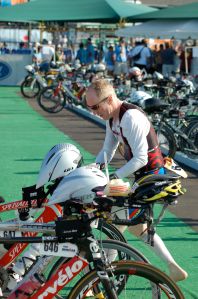
Moving a little slowly in T1
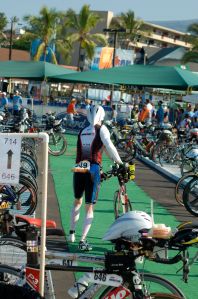
Moving a little slowly in T1

See you in a little over 6 hours!

See you in a little over 6 hours!

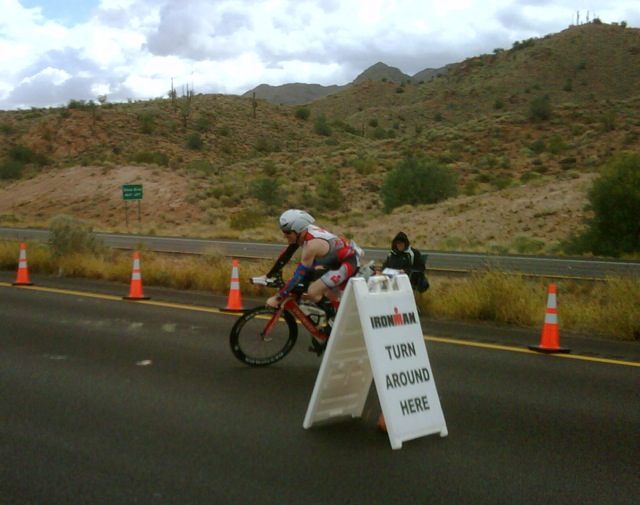
Off on the bike – the longest part of the day was beginning.  The advice I was given was to take the initial out-and-back in town along Kuakini Hwy very easy and focus on re-hydrating and getting some calories in.  It already felt pretty warm at 8:30 in the morning, but this was just a teaser for what was to come.  Off of Kuakini, up the short steep climb of Palani and then left on the Queen K.  So far so good.

One effect of the heat is that your heart rate spikes much higher than it normally would at a given level of effort.  I am normally comfortably aerobic (less than 130 bpm) at around 200 watts, but on race day once I hit 200 watts or above, my heart rate was a good 10-15 bpm higher.  I decided to back off and let my heart rate rather than my power meter rule.  There are lots of little things to think about as you’re riding along – obeying the no-drafting rules, passing groups of riders while someone else may be coming up on you, taking some sips of fluid, popping an electrolyte caplet every 20 or so minutes – so the time passed quickly.  I finally got into some familiar territory as I passed the Mauna Lani resort at around mile 33 – now I was on the part of the course that we do in the Honu half-IM race in May.  That was both good news and bad news – good news because I knew what to expect; bad news because I knew what to expect:  uphills and wind.

On the downhill into Kawaihae, I got my first reality check in the form of race leader Chris Lieto coming the other way.  At that point, he was probably 90 minutes in front of me, even though he only had a 15-minute headstart at the beginning of the day.  I’m used to the pros being way in front, but I’d never experienced this far in front.  A little depressing.

All along the way up to Hawi, I saw a steady stream of riders on their way back – first the male pro chasers, then Chrissie Wellington and all other female pros competing for second place, all intermingled with second-tier male pros and top age groupers.  The journey to Hawi doesn’t get difficult until about 7 miles to go, when it turns into a steady uphill.  There was a steady headwind on the climb, but it wasn’t ridiculously strong as it has been in some years, most recently in 2004.  I thought I was going to luck out with a relatively benign day, and I was on pace to ride a conservative 5:45.

The turnaround in Hawi Town came, and now I was on the downhill slope – about 50 miles to go.  The descent initially felt great; I was moving at 30+ mph, was tucked in my aerobars and was not feeling any of the dreaded crosswinds that can blow you across the road.  Thing was going to be fun, I thought.

Then came the curve at Mahukona, and BOOM, the wind hit.  Strong gusts occasionally, but mostly a steady headwind, one that I would combat all the way back to Kawaihae.  I was otherwise doing pretty well, though my left foot was beginning to hurt, so I loosened the strap on my shoe, which gave me some relief.  Nutrition-wise, I was doing pretty well, though I felt a distinct lack of power in the legs.  Perhaps the inability to ingest calories early in the ride was catching up with me.  There’s a pretty steep uphill out of Kawaihae that is actually one of the toughest on the entire bike course, and then we turned onto the Queen K for the ~30 miles home.

Tailwind?  Not a chance – I was greeted with the worst headwind of the day, one that I would battle against for the next 30 miles.  I was going 12-13 mph on the uphills and only 17-18 on the downhills!  I started feeling a little sorry for myself, but made myself get a grip.  “This is the Ironman,” I told myself, “it’s supposed to be hard.  But just remember:  it always gets better.”  I started counting down the landmarks:  Hapuna Beach, Puako, the Mauna Lani, Waikoloa, the Hualalai resort, the airport, at which point I knew I would be at least getting an interesting sight – the lead runners coming out of the Natural Energy Lab.  Interesting, but depressing.

I’m a realist, after all – I’m not a pro.  I’m not even a particularly good amateur.  But I had been improving steadily at the Ironman, and yet this would be the one in which I came the closest to not being off the bike yet before the winner finished the run.  I could see a number of the lead pros on their way back, and was trying to spot who was who even as I was getting prepared to get off the bike.  I came up on Lieto, who  seemed to be running pretty fast, so I thought he might still be in the lead, but a minute or so later I passed Craig Alexander.  It looked as though history was going to repeat itself.

Fortunately for my ego, they still had a couple of miles to go, so I easily made it into T2, notching an all-time personal worst in the Ironman bike of 6:22 (PW by a lot), with time to get changed and out on the run course before the winner came in.  As I turned on Hualalai to get down to the first out and back on Ali’i Drive, I heard the crowd cheering loudly all of a sudden, so I figured the lead runner was somewhere back behind me but closing quickly.  I believe I narrowly avoided being passed by Craig Alexander as I turned onto Ali’i.  I probably missed some good NBC camera time – d’oh!

Now it was time to settle into a steady pace and deal with my own race, which first meant addressing my overheated body.  My plan was to walk the aid stations, taking in as much fluids and ice as I could – a kind of Gallowalking, I guess, but one that 8-time champion Paula Newby-Fraser used to use.  Mile 1 was a surprisingly quick 7:51, so I definitely needed to simmer down.  There was no way I was going to run a sub 3:30 under these conditions.
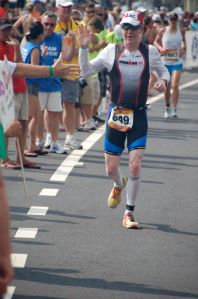
First mile of the run

First mile of the run

One thing I had never tried before in an Ironman was a tip I got from Roch Frey:  dumping ice down my shorts.  That sounds weird and potentially painful as well, but I can attest to its effectiveness – the part of the course on Ali’i (the first 10 miles, basically) was an absolute sauna, and as soon as I put the ice down there, my heart rate dropped by a few beats and my pace picked up.  Things kind of jiggled, but what the heck.  I was hitting my miles right around 9:00 each, give or take depending on how long I lingered at each aid station, and while I knew that 3:30 was out, I thought I might be able to break 4:00, which would be an accomplishment under these conditions.  A quick bit of math told me that would also bring me in under 12 hours, and that would mean that I would continue my Ironman streak of never going over 12 hours.  That settled it – I made that my new goal.

Not that it really mattered in the grand scheme of things, but at that moment it became my all-consuming focus, and let’s face it:  when it’s broiling hot, you’re tired, your feet hurt and your shorts are full of ice, you need a reason – any reason – to keep running.  So my motto became “Sub 4 Or Bust!”
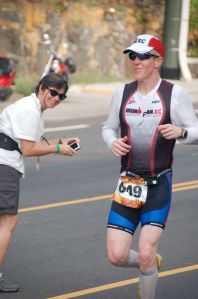
10 miles down; 16.2 to go!

10 miles down; 16.2 to go!

Back in town at mile 10, I caught up with my entourage, and they claim I was smiling.  That might have been a grimace, but if people thought it was a smile, all the better.  I walked up the steep uphill of Palani in order to keep my heart rate low, and then we turned onto the Queen K.  One more out and back (16 miles’ worth), and I would be done!

All the miles were though at this point, though mentally the ones from 11 to 16 before the turn into the Energy Lab were probably the hardest mentally, just because I had so far to go and was seeing runner after runner on their return journey home.  The key to retaining focus during the tough times was to take the race one mile at a time – just run aid station to aid station.  My miles were still in the 9:00-9:30 range, which meant I was still on track.  Just keep grabbing what I needed at each aid station, I told myself, and I would be able to maintain the pace.

The Energy Lab was magic – as I descended into it, the big Pacific Ocean was in front of me, and the sky was setting up for a beautiful sunset.  With 7 miles to go, an impending sunset meant I was going to be finishing in the dark for the first time ever, but it was kind of cool to get the glow stick a volunteer handed me.  At mile 20, I calculated I needed to run about an hour for the last 10K in order to break 12 hours.  My pace was still steady, but I was working.

I felt a cramp starting to form, but being in between aid stations, I didn’t have any liquids so I tried to swallow a Succeed cap dry.  It wouldn’t go down my throat – it just sat there in the esophagus, and I was starting to get the dry heaves as my throat tried to force it out.  I kept my breathing controlled and tried not to swallow, and then I got a brilliant idea – I had put some ice down my shirt, so I grabbed a few cubes and put them in my mouth.  Soon enough the cubes had become cold water, and voila, I was able swallow the cap.  Crisis averted!

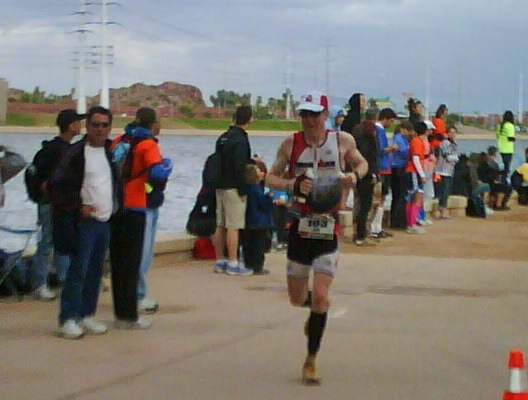
Now it was make or break time.  Starting after mile 22, I decided not to walk any more of the aid stations and just make a steady push for the finish.  It was dark, but I was coming up on the occasional runner or group of runners and going by pretty quickly.  With about 5K to go, a guy running a strong steady pace went by me, and I think he was the only guy to pass me all day long (not that that was a huge deal given that I was in the bottom half of the field, but I’ll take anything I can get).  The miles counted down quickly, and pretty soon I was making the steep descent down Palani in the last mile of the race.  I tore down Hualalai and this time got to make the right turn onto Ali’i, at which point I had to remind myself not to just sprint home but to enjoy this final stretch, the final parade to the finish line.  Coming into the fenced-off chute in the final few yards, I saw my friend Michael and gave him a high-five, then high-fived every spectator whose outstretched hand I could see.
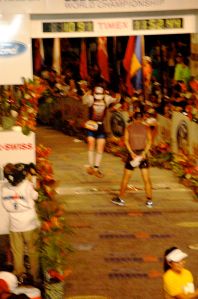
About to execute a front handspring?

About to execute a front handspring?

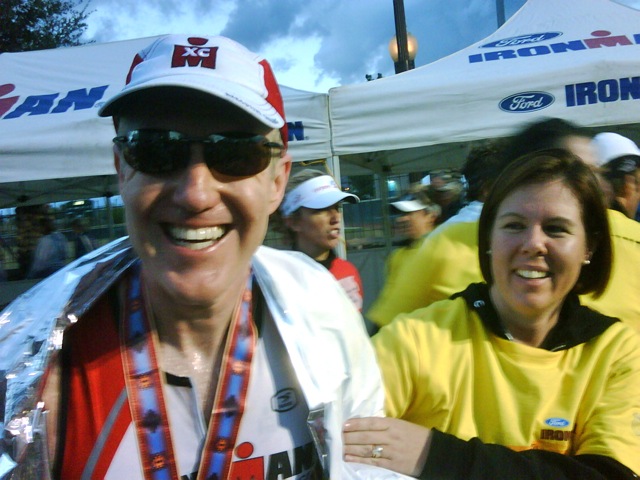
Over the finish line I did the biggest vertical leap I could muster and pumped my fist.  11:52:44 – “Ian Hersey….you…are…an IRONMAN!”  I was quickly surrounded by volunteers, my wife Jeanne and my parents and friends.  The next few minutes are still a blur, because I felt both exhilarated and also somewhat ill.  It was still very hot out, so I collected my finisher’s medal and shirt, and then headed for the comfort of the air-conditioned race hotel.  After some couch time, food and drink, I started to feel better.  As some evidence of the effort I had put out, though, I should mention that I peed blood for the next 3 days.
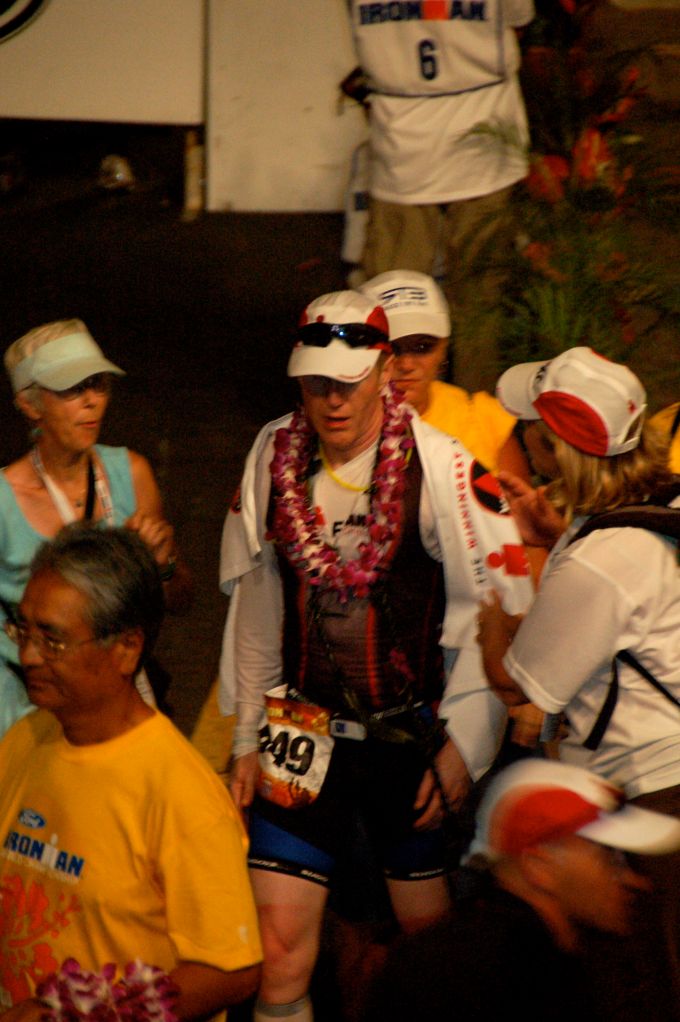
My finish-line entourage!

My finish-line entourage!

There are some memorable lines from some of the recent NBC broadcasts of the Ironman – I particularly like Al Trautwig’s dramatic delivery:  “You can learn a lot about life…on the Big Island of Hawaii.”  Perhaps that’s more than just good television – I certainly learned a lot about myself.  Despite subpar times in the swim and bike and some very challenging conditions, I never gave up and in fact put in the most evenly-paced run I’ve ever done in the Ironman.  And I accomplished a goal I had been pursuing for over 4 years, one that took blood, sweat and tears to accomplish.

So at the next social gathering where I tell someone I do Ironman triathlons and they ask, “oh, have you done the Ironman in Hawaii,” my answer will be, “why yes…yes I have!”

The tale of the tape:

Ian Hersey

BIB

AGE

STATE/COUNTRY

PROFESSION

649

47

Menlo Park CA USA / USA

Business Executive

SWIM

BIKE

RUN

OVERALL

RANK

DIV.POS.

1:24:24

6:22:14

3:56:25

11:52:41

1094

116

Run to the Sun (Maui)

I got talked into doing this race as part of a 3-person relay by my teammates, Rita and Michael.  Sure, the race is pretty much all uphill.  Sure, it starts at sea level at 4:30 a.m. and ends at 10,000 ft at the summit of Haleakala.  Sure, uphill running’s not my strength.

But who can resist a challenge?

I agreed to come to Maui for this thing (twist my arm), and somehow talked my way into doing the last 12 or so miles.  The miles at the highest altitude (I live at sea level).  To be fair, Rita and MIchael live at sea level too, so someone had to do it.  Besides, when I rode a bike up the crater back in October, I didn’t have too much difficulty in the thin air, so I figured what the hey.

It was a weird weather week in Maui — cool, windy and rainy — and race day was no different.  Forecast was for the low 30s F at the summit, with 40 mph winds to make it that much more pleasant.  Since Crater Road has a bunch of switchbacks at the top, I was probably looking at a tailwind in one direction and a headwind in the other.

I arranged to meet the team at the very latest at the handoff point less than a mile before the pay gate at Haleakala National Park, altitude about 6700 ft.  Before we got up there, though, we found the rest of the team on the lower section of switchbacks that started just after Kula.  Rita was on leg 3, and was a few minutes from handing off to Michael, who would then hand off to me for my legs 5 and 6.  Rita’s husband George was driving the support vehicle, so I transferred my gear to that car and bade farewell to my wife Jeanne, sending her back down to the relative warmth of Ka’anapali.

Rita got done and handed off to Michael, and she, George and I headed up about 6 miles further to my starting point.  I could feel the altitude as I walked up a little hill to take a covert bio break — yep, 6700 ft. is kinda high!  Got all fueled up, and Michael came around the last bend within 10 minutes of his predicted time for this point in the race, so we were on track for a sub 6:30 finish as long as I didn’t crumble.

I actually had no idea what kind of pace I could run; I think Michael’s stats sheet put me at around 8:30 pace, which seemed a little ambitious for high altitude and steady uphill, but in the end I would have to go by heart rate and perceived effort level anyway.  My one experience in an uphill race, the 2004 Pikes Peak Ascent, had shown a dropoff in heart rate as the elevation got higher.  That race was not among my finest moments, but I was hoping this would be different, since it didn’t go nearly as high (PP is over 14,000 ft.) and since the pitch wasn’t nearly as steep (I believe Haleakala averages 6%).

Anyway, I was off and feeling ok, letting my heart rate settle in at about 150 bpm.  I started reeling in folks pretty quickly, but a lot of them were solo runners, so it was understandable that I was going by them — they were going for the full 36 miles and were already 24 miles in when I started my leg.  The wind wasn’t bad in the beginning, but once I was well into the park and on the switchbacks, the wind came with a fury.  Lower down, you go a pretty long way in one direction before hitting a turn and going the other direction, but as you ascend the straight stretches get progressively shorter.  At some points, the winds were absolutely howling, and I felt pretty sorry for the poor aid station volunteers that were standing out in the elements.  It was getting fairly cold, too.

I passed the sign for 8000 ft less than an hour into the run and was figuring on a time of about 1:40 for my leg, give or take, which would still get us under 6:30.  The headwind sections were tough, though, but the tailwind sections were great — I felt like someone was pushing me up the hill.  I took full advantage of those moments and let my legs fly.  I was still reeling people in.

I passed 9000 ft., and I could start to smell the barn.  It came sooner than I thought:  the race director made the call to end the race before the top, which was icy and hazardous, so when I saw my teammates at the next aid station, they told me I only had a mile to go instead of 3 miles.  The reader might assume I would be disappointed with that news, disappointed with not being able to do “the whole thing,” but actually the reader would be wrong.  I was cold and ready to be done, so I picked up the pace and finished with a surge.   I crossed the line, and was greeted with a maile, some medals and a blanket.

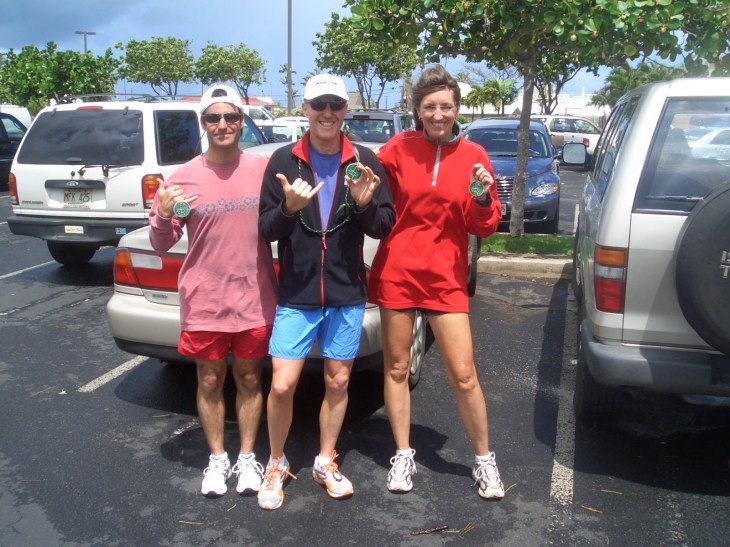
My time was 1:28:37 for about 10 miles; our team finished in something like 6:18 and won the mixed relay division.  Here we are back down near the starting line afterwards:

From left:  Michael, Ian, Rita (photo by George)

From left: Michael, Ian, Rita (photo by George)

Here’s what the weather was like at the summit:

Why the Run to the Sun ended early (photo by Rita)

Why the Run to the Sun ended early (photo by Rita)

As always happens, the day after the event had the most gorgeous weather, at least in the afternoon.  All the better to enjoy Maui by!

Epiclog

Five days after Epic Camp I find myself with quite a different perspective on the whole thing. During the camp, it was difficult to think of anything except the suffering, the fatigue and the reality that most of the campers were way out of my league. Yet, as I said from the beginning, I went there not to compare myself to the pros and to the top age groupers, but to push myself beyond where I had ever gone in training. By my reckoning (and that of my Polar watch), I did 34h 17m of training in the first 7 days of the camp — easily double my biggest-ever training week.

Immediately after the camp, I couldn’t feel any difference other than fatigue. I got home and reassembled my bike, though, and got on the trainer last night after a heavy meal that included a couple of glasses of wine.

At first, I just wanted to see how things went. My CompuTrainer allows me to set the wattage I want to ride, so I moved up through my usual curve of very easy (100 watts) to easy (130-140) during the warmup. But a funny thing happened — my heart rate was still really low, and I didn’t feel as though I were working at all.

I decided to do the equivalent of the blood lactate test they do at Endurance PTC.  This involves 3-minute sets of step-ups of 3o watts every 3 minutes; I did this test a year ago to determine my Ironman and lactate threshold values.  The year-ago values were 190 watts @ 128 bpm for the steady-state lactate value and 230 watts @ 146 bpm for “threshold.”

I didn’t have anyone measuring the actual blood lactate, so I just used the heart-rate values as a guide, approximate though they are.  At 190 watts, I would have expected to hit 128 bpm by the end of the 3 minutes; instead I was only around 110 and still felt really easy.  I moved up to 220 and only hit 120 bpm by the end of the 3 minutes, and then I moved up to 250.  It took until the third minute when I finally hit 128 bpm, and I still had plenty in the tank.  Anyway, I estimate the equivalent value to be 240-250 watts — at least it was last night.  That is a significant improvement.

Moreover, I didn’t reach 146 bpm even by the end of the third minute @ 280 watts; after that, I decided to warm down just because I got the advice not to push it too much after the camp.  But I am really encouraged by the numbers and wonder whether they’re real.  If so, it really supports the volume theory over everything else.

The other thing I can say is that despite being the camp slacker, I really did do what I could every day, knowing of course that I could only go so deep and still be able to do anything the next day and the day after that.  So I did “pace” myself.  But I also endured many moments when I didn’t want to be on the bike and still got on, whether it was general fatigue or my butt really hurting or whatever.  The point is, I stretched myself way beyond my previous limits, and I see signs that it will pay off.

Day 8: Events day

Today was the final day of Epic — what’s referred to as “events day.” The morning started off with all of us going to the Nayland pool for three events: the 400 IM, the 200 kick and the 50 free. There wasn’t a “swimming challenged” category, so I opted out and instead did timing and recording, though now I kind of wish I’d jumped in.

It’s fun to watch the big guns, though — Heath Thurston is a swimming machine, opening with a 1:10 in the fly during the IM (in a 50m pool), but maybe most impressive of all was his performance in the 200 kick. He went through the 100 in 1:30; I’m not sure I could do that swimming all out. I need to get my butt to the pool more often, obviously.

The midday event was an Olympic distance triathlon that had a 13-mile warmup ride to the beach at Rabbit Island. Once there, we had to swim a very long “1500m” course that involved three times around a set of buoys that were allegedly 250m apart. All I know is that swim times were very long, and the big swells continued the feeling of “Kiwi rollers” that we’ve been having the whole time on the bike. I was swimming with Dave, the lead guy of the support crew, but he peeled off (unbeknownst to me) after 2 laps, so I was on my own in DFL (dead f***ing last) place. My time to the beach was 38:xx, so there was no way this was only 1500m — my normal swim would be 25-26 minutes.

I took my time in transition; the day was hot, the sun was high, and I needed to protect my lilywhite skin from the harsh Kiwi sun, so rather than wear a tri top, I donned a normal bike jersey. Once out, it was 6k out to the main road, then 10k in one direction, which led us into a series of the famous Kiwi rollers. After maybe 3 miles, I started seeing the frontrunners (John Newsom follwed by Chris McDonald) coming the other way, which meant I was about 6 miles out of the lead.

After the turnaround, to my chagrin I found we were heading into a “sea breeze” (i.e., headwind) going back towards Nelson. This was going to be harder than I wanted, and by 10 miles to go, both my bottles were empty and my left Achilles was complaining a little. I backed off the pace then and just cruised in in about 1:20. A couple of guys ahead of me were catchable given my relatively superior running, but given my tight Achilles, I opted to bag the run. No use getting another calf strain that would cost me another month of running.

All in all, a fun way to end the camp. Actually, the more fun way was right after the race, when we headed over to “The Honest Lawyer” pub, which has a beautiful waterside setting. The beer was flowing, the sun was out, and life was great.

Day 7: What was this about resting on the 7th day?

This morning when I got out of bed, I realized something: I, like a lot of competitive age groupers, dream of what we could do if we could train full time like the pros do. Having had a taste of what the pros do, I think I’ll keep my day job.

It was hard to get on my bike today — I just lacked any sort of motivation. Unfortunately, it wasn’t exactly an easy day: about 100 miles of cycling, split up in the middle by a 2k cold lake swim and a 10k-ish trail run. It was 51 miles out to the lake, and included a long series of climbs that were — true to the stereotype &mdash uphill and into the wind.

I had gotten spit off the back after about 19 miles (still have my front brake issue so I couldn’t ride in the pack), and going up the road towards St. Arnaud, I had absolutely no power in my legs. So I got in the van at around 25 miles with the idea of getting back on the bike after the swim, run and lunch, and seeing how it went.

The lake was pretty cold but very clear, and we did a 4-lap triangle that worked out to around a mile. After the initial shock of the cold (even in a wetsuit), I ended up having my best swim of the entire camp (judging by who I finished near). The trail run was nice and leisurely, just getting the time on our feet (like we really need it). After a good picnic lunch lakeside, I climbed back on my bike with the goal of getting to at least 50 miles for the day.

As much uphill as there had been on the way out, the way back wasn’t entirely downhill. Each series of hills on the way out had had several miles of downhill before going up again, so we had to go up that downhill this time. Not only that, the wind had shifted, and we now had a headwind going back! Doh!

Still, I felt comfortable in my aero bars, and I took full advantage of the downhills, despite the lack of braking power. There were some curves, but none required braking, fortunately. I figured I’d get my 90k (56 miles) in and climb in the van — the only problem was, the van never came. We were so spread out by that point that Sarah, the driver, had problems covering the entire field, so the further I got, the more likely it became that I would just ride on in, which would put me at 120k (75 miles) or so. Not bad considering how terrible I felt at the beginning of the day. I ended up with 76 miles.

So my 7-day total is about 12k of swimming, 425 miles of cycling, and 66k of running. I’ll have to add up the total hours, but it’s a lot — easily the most I’ve ever done, maybe by more than double.

Tomorrow is “events day” — which I involves a little triathlon in and around Nelson. Not sure I’m ready to race at this point, but if anyone’s catchable on the run, you can be sure I’ll try…

Day 6: Up and over

Today we left Collingwood and went back over the Takaka Hill climb to the beach at Little Kaiteriteri, where we did an “aquathon” consisting of a 2k swim and 8k run. I had some mechanical issues with my bike that started yesterday; John the bike doctor fixed one of them, but my front brake requires a part that wasn’t available in Collingwood, so I was riding with almost no front brake. That meant I couldn’t do the descent off of Takaka Hill, but I could do the ride out of Collingwood and the climb up Takaka Hill, then put my bike on the van for the ride down. So I did just that.

The ride up was hard; I got spit off the back of the group about 5 miles before the climb started, so I was doing it on my own. I did catch up to the guy who sat on my wheel the other day up the other side of the climb, and sure enough he glommed on again. Unfortunately, I didn’t have the strength to drop him &mdash I tried a couple of times. 😉 As we approach the summit, I turned around and said, “I guess you’re going to sprint past me at the end just like the other day, so go ahead.” He made some mumbling statement about needing the points and getting his ass kicked every day. Whatever. Fortunately, I run a lot faster than he does, so I figured we’d see what happened in the aquathon.

Kaiteriteri was really a day at the beach &mdash it was hot and sunny. The water, though, was great, and we got some instructions for the course that I kind of half paid attention to. Bad idea, because since I’m the weakest swimmer in the camp, I got spit off the back pretty quickly and had trouble following the course. I found the first set of rocks we had to turn at, but then I couldn’t see any of the buoys (small and black, so not the easiest to spot when you don’t exactly have eagle eyes), so I swam in the approximate direction and hoped for the best. I finally found them, but once past them, I headed back to what I thought was the right set of rocks (the same ones we had gone around at the beginning), but it turns out they were a different set of rocks altogether &mdash much further out.

Once I reach them, I realized my mistake and headed back in, but I was last out by probably 10 minutes. Probably too much to make up in a 5-mile run, but I headed out and went on the hunt. I saw the entire field going the other way, but my wheelsucking friend was in the back and looked catchable. By the beginning of the second loop, I had indeed caught and passed him (I was doing maybe 6:30 pace). I realized, though, that there was a short out and back section that I had inadvertently skipped on the first loop, so I knew I had to do it on the second and therefore needed enough time on the guy to avoid a next-to-last placing (one of the campers was injured so was walking). Mission accomplished, with minutes to spare. 🙂

Then we had 16 or so miles of pedaling again to the Neudorf winery, where we enjoyed several glasses of wine each and some snacks. I thought I’d still be full from lunch, but I was ravenous.

As nice as the end of the day was, the camp is far from over. Tomorrow is a very hard 180k ride; hopefully I will have working front brakes by then.